
Post-PDT Buying Power: The New Intraday Margin Math
The PDT rule's $25K floor is gone, replaced by a real-time intraday margin standard under Rule 4210(d)(2). Here's how the new buying-power math actually works.
Body

The short version
The Pattern Day Trader rule is gone. In its place is a real-time intraday margin standard under amended FINRA Rule 4210(d)(2) that tracks position risk continuously instead of counting trades. For large-cap, low-volatility longs, buying power is roughly preserved or slightly looser. For low-float small-cap momentum and 0DTE options — the stuff many active retail traders actually trade — buying power may be materially tighter once broker house haircuts kick in. Effective date: June 4, 2026, with an 18-month phase-in permitted.
What's changing and when
On April 14, 2026, the SEC issued Release No. 34-105226 granting accelerated approval to FINRA's proposed amendments to Rule 4210 (File No. SR-FINRA-2025-017, as modified by Amendment No. 1). FINRA Regulatory Notice 26-10 sets the effective date at June 4, 2026, 45 days from publication, with members permitted to phase in implementation over 18 months — until October 20, 2027.
This post is the mechanics post. For a broader narrative of what happened and why, see our earlier write-up on the elimination of the PDT rule.
The old buying power formula
Under the eliminated paragraph (f)(8)(B), "day-trading buying power" for a Pattern Day Trader had a specific formula:
``` BP_DT = 4 × Maintenance Margin Excess (MME) ```
where Maintenance Margin Excess is account equity minus the maintenance margin requirement on open positions. The 4× multiplier only applied to accounts flagged as PDT and with equity ≥ $25,000 at the prior-day close. Below that, the account was frozen for 90 days or until topped up.
Worked example (old rule). A PDT-flagged account with $25,000 equity and no open positions has MME = $25,000 and intraday BP = $100,000. Open $40,000 of AAPL long at 25% maintenance → maintenance requirement = $10,000 → MME = $15,000 → remaining intraday BP = $60,000. Close the position intraday and BP snaps back to $100,000.
Two things to notice about this framework. First, it didn't care what you were buying — AAPL, a $2 penny runner, or SPY 0DTE calls all consumed the same 25% maintenance haircut at the FINRA minimum. Second, sub-$25K accounts were binary: flagged and frozen, or under the radar and free to trade up to four round-trips per five business days before the hammer dropped.
The new intraday margin framework
The core operative provision lives in new paragraph (d)(2) of Rule 4210. Instead of asking "is this a day trade?", the rule now asks, continuously through the session: "does this account have enough equity to cover the maintenance margin on everything it currently holds?"
Three mechanical pieces matter:
1. Intraday Margin Level (IML). Conceptually, IML is the amount the customer could withdraw at any instant while still meeting the account's maintenance margin requirement. In formula terms:
``` IML = Account Equity − Σ (Position Notional × Maintenance Haircut) ```
Any transaction that reduces that number is an "IML-reducing transaction" — per the rule, this includes "the execution of a short sale or the purchase of a security other than to cover a short position" (paragraph (d)(2), definitions). Opening a long, adding to an existing position, or opening a short all qualify.
2. Intraday Margin Deficit. For any business day in which the account has at least one IML-reducing transaction, the member firm must determine the intraday margin deficit, defined under (d)(2)(B) as an amount not less than the absolute value of the largest negative IML observed in the account that day. Critically, FINRA gives members flexibility in how they compute this: either a single end-of-day calculation that captures the worst intraday point, or multiple real-time snapshots through the session (Regulatory Notice 26-10, paragraph (d)(2)(B) methodology).
3. Cure, enforcement, and the new 90-day restriction. Under (d)(2)(C) and (d)(2)(D), any intraday margin deficit must be satisfied "as promptly as possible" via deposit or liquidation. If the deficit is not cured by the close of business on the fifth business day, the member must deduct the unsatisfied amount from its net capital for up to ten business days. If the customer "makes a practice of failing to satisfy intraday margin deficits as promptly as possible" and also misses the five-business-day deadline, the member must enforce written policies preventing that customer from "creating or increasing a short position or debit balance (other than by closing a short position) for 90 calendar days" (Regulatory Notice 26-10, paragraph (d)(2)(D)).
There is one important thing the new framework is not: a brand-new volatility model. FINRA did not introduce VaR-style haircuts or a prescribed stress-scenario scheme at the standard-margin level. The "dynamic" behavior of the new standard comes from two layers stacked on top of each other:
- Existing Rule 4210(c) maintenance percentages — 25% on standard long equities, 30% on shorts, higher for low-priced securities, with concentration add-ons.
- Broker house margin policies — firms can (and do) apply tighter haircuts than the FINRA minimum, and routinely flag volatile small-caps, low-float runners, and recently-IPO'd names with elevated requirements. House haircuts of 50–100% on low-float momentum tickers are common today and will remain common.
What is new for the margin-stack is (a) these haircuts now apply intraday and in real time, not just at the close, and (b) FINRA explicitly closed a gap around same-day-expiry options. Under the old rule, same-day open-and-close of 0DTE options frequently did not qualify as "day trading" at all, meaning the positions ran without day-trade margin coverage during the session. The proposal text notes that the new framework is designed to capture "intraday risk created by day trades and other intraday activity, such as transactions in options on their expiration dates ('zero day to expiration' or '0DTE' options trading)" (SR-FINRA-2025-017, Purpose section).
For accounts under portfolio margin, new paragraphs (g)(1)(J) and (g)(1)(K) require portfolio-margin accounts with less than $5 million in equity to maintain intraday margin "substantially similar" to end-of-day margin — closing the same gap for the retail-adjacent portfolio-margin segment.
The $2,000 Reg T floor for opening a margin account remains unchanged. What's gone is the $25,000 overlay specific to day trading.
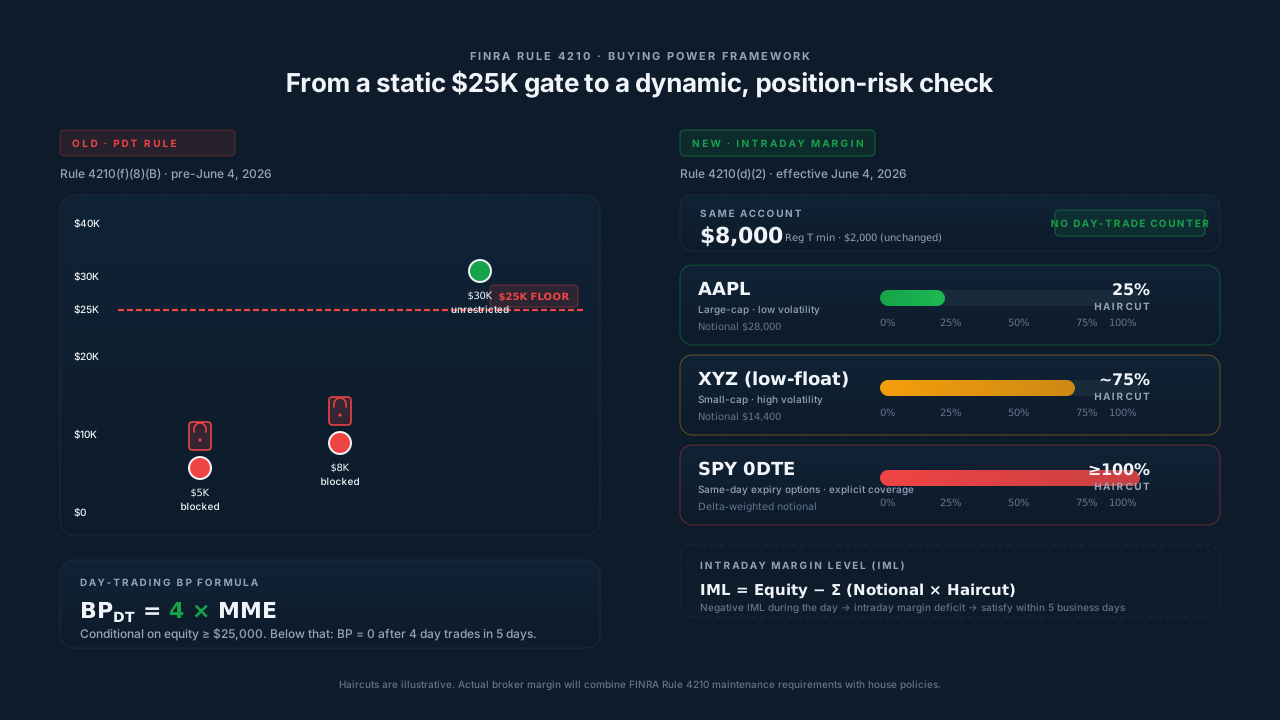
Three worked examples: same $8,000 account, three scenarios
To make the mechanics concrete, assume the same margin account — $8,000 equity, no existing positions, post-June 4, 2026 — under three different trade setups. These are illustrative; exact requirements will depend on your broker's house margin matrix.
Trader A — Long AAPL (large-cap, low volatility)
- Regulatory minimum maintenance (Rule 4210(c)): 25% long equity.
- Typical broker house haircut on AAPL: 25–30%.
- Using a 25% haircut: max notional supported by $8,000 of equity = $8,000 ÷ 0.25 = $32,000 of AAPL exposure intraday.
- Effective intraday buying power: roughly 4:1.
Opening a $24,000 AAPL long leaves IML = $8,000 − ($24,000 × 0.25) = $2,000 of intraday buffer. Close before the close, IML snaps back to $8,000, no deficit, no counter, no flag. This is the case the new framework was primarily designed to enable: a disciplined trader on a sub-$25K account gets meaningful intraday access to marginable blue chips.
Trader B — Long XYZ (low-float small-cap momentum runner)
- Regulatory minimum maintenance: still 25% at the floor — but low-priced and low-float tickers routinely incur house haircuts substantially higher.
- Typical broker house haircut on a low-float runner: 50–100% depending on the broker, the price, average daily volume, and float. 100% is common when a name is on a broker's "no-margin" list.
- Using a 75% haircut: max notional = $8,000 ÷ 0.75 ≈ $10,667.
- Effective intraday buying power: roughly 1.3:1 on this ticker — tighter than the pre-PDT 4:1.
This is the most important point for momentum traders to internalize: the elimination of the PDT rule does not hand you 4:1 on everything. On the specific tickers that small-cap momentum strategies are built around, broker house margin is the binding constraint, and house margin on low-float is materially tighter than the FINRA floor. The new framework applies that tighter haircut intraday and in real time. If the stock gaps 40% against you during a hold, your IML goes negative immediately, and you're on a five-business-day clock to cure.
Trader C — Long SPY 0DTE options (same-day expiry)
- Treatment under the old rule: frequently didn't qualify as a "day trade" if opened and closed within the session, meaning no day-trade margin applied at all during the hold.
- Treatment under the new rule: explicitly covered by the language of (d)(2) targeting "transactions in options on their expiration dates" (SR-FINRA-2025-017).
- Long options premium: under Reg T, long option premium is 100% cash (no margin is extended). In practice, IML impact equals the full premium paid.
- Using $8,000 of equity: you can pay up to $8,000 of premium; at that point IML = $8,000 − $8,000 = $0, right at the edge.
- Short or spread structures: different calculation, governed by existing Rule 4210(f)(2) option-margin provisions, with intraday application.
The practical effect for 0DTE traders: the strategy keeps working, but the sizing math tightens. There is no more "open at 10:00, close at 14:30, never counted as a day trade" escape hatch — the intraday exposure is measured and capitalized against in real time.
What this means for active traders
The honest read on who benefits and who gets constrained:
- Sub-$25K blue-chip traders benefit the most. If your book is AAPL, MSFT, NVDA, SPY, QQQ, and similar, the elimination of the $25K gate and the 4-in-5-days counter is a clean upgrade. Buying power in the $3–4 range of your equity becomes available without any qualifying hoops.
- Small-cap momentum and low-float traders may see tighter intraday BP. The new framework exposes you to the real house-margin picture intraday, not just at end of day. A 75% or 100% haircut on a low-float runner was always there in the background; the difference is that now it is actively computed against your IML at every moment the position is open.
- 0DTE options traders lose a quiet loophole. Intraday exposure in 0DTE is now explicitly covered. Strategies that relied on not being counted as day trades because of the same-session expiry will need to be re-sized to the new intraday margin math.
- Repeat offenders get a new enforcement tool. The 90-day short/debit restriction under (d)(2)(D) replaces the old 90-day freeze mechanic, but applies at the intraday margin deficit level rather than at the day-trade-count level. The mechanism is narrower (aimed at people "making a practice" of unsatisfied deficits) but no less real.
The slogan "PDT is dead, you can now trade with 4:1" is only true for a subset of strategies. For volatility-forward intraday strategies, the new standard is both more flexible and more conservative — flexible because it removes arbitrary trade counts, conservative because it prices position risk continuously.
Broker implementation caveats
Two things to flag as of writing (late April 2026):
First, brokers can set stricter requirements than the FINRA minimums, and will. Nothing in Rule 4210(d)(2) prevents a firm from applying 100% haircuts to low-priced securities, specific tickers, or entire sectors it considers elevated-risk. Expect the house-margin screens at Schwab, E*TRADE, Interactive Brokers, Webull, and Robinhood to get more visibility, not less, as firms move to real-time monitoring.
Second, rollout timing is not uniform. Webull has publicly committed to enabling the new rules immediately on the effective date. Charles Schwab's published guidance indicates the firm plans to monitor accounts and adjust intraday buying power in real time for eligible margin accounts above $2,000. Interactive Brokers, which already runs real-time margin monitoring institutionally, is expected to move early but has not published a firm date. Robinhood publicly supported the rule change during the comment period and is expected among the early adopters. The 18-month phase-in window (through October 20, 2027) means some firms will take substantially longer. Exact numbers for house haircuts by ticker are TBD per broker — check your firm's margin table before sizing into a new position under the new rules.
We'll maintain a live broker-implementation tracker as firms publish their matrices.
Bottom line
The new intraday margin framework is a genuine philosophical shift: from one hard threshold to a continuous, position-risk-based calculation grounded in Rule 4210(c) maintenance margin applied intraday. For large-cap intraday traders under $25K, it's a straightforward win. For small-cap momentum and 0DTE options traders, it's a tighter, more honest measurement of the risk that was always there — with real teeth in the five-business-day cure window and the 90-day (d)(2)(D) restriction for repeat offenders.
The math is knowable. The numbers will be your broker's. Run the IML formula on your typical setup before June 4, and don't assume the headline "PDT is gone" means your specific strategy just got 4:1.
---
_This article is for educational purposes only and does not constitute legal, regulatory, tax, or financial advice. Exact intraday margin requirements will depend on your broker's house policies in addition to FINRA Rule 4210 minimums. Verify current requirements with your broker before trading under the new rules._
Sources: SEC Release No. 34-105226 (SR-FINRA-2025-017, as modified by Amendment No. 1); FINRA Regulatory Notice 26-10; amended FINRA Rule 4210 paragraphs (d)(2), (g)(1)(J)–(K); Federal Register publication dated April 17, 2026 (2026-07485).